
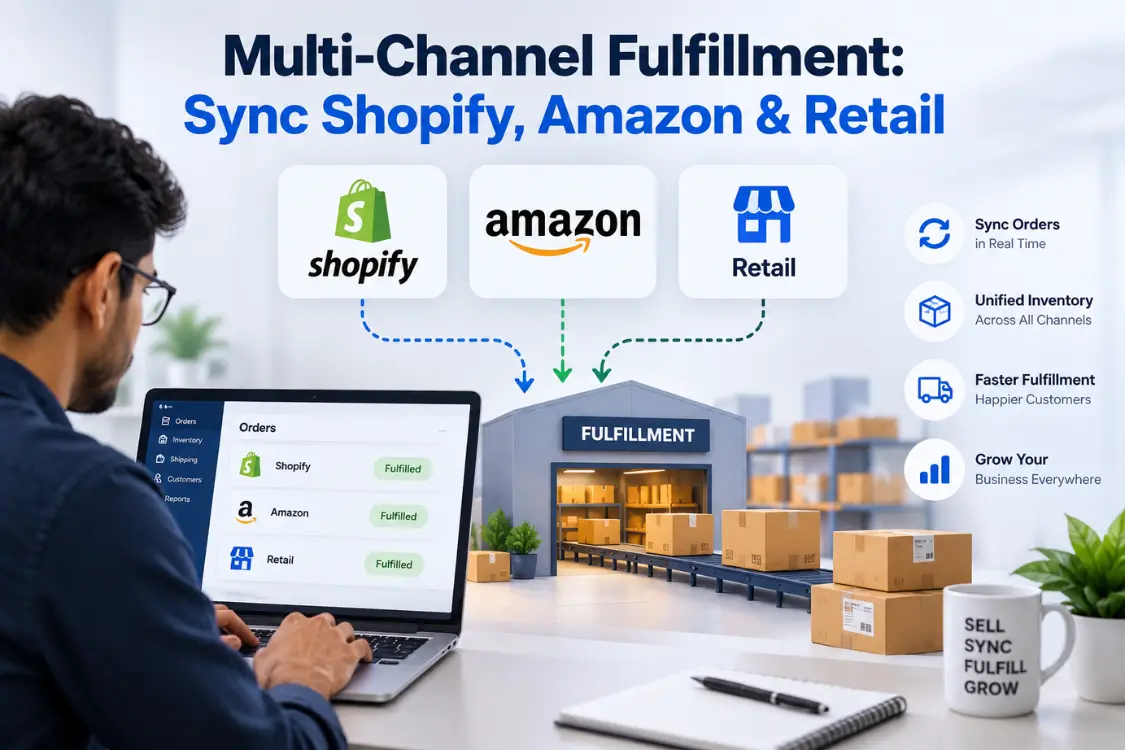
Sell on Shopify, Amazon & Retail for more opportunities to grow your brand. But as your channels grow, multi channel fulfilment becomes more complicated.
Your 3PL may have already allocated most of a product’s inventory to Amazon orders, while Shopify still shows 12 units available. Those systems need to be updated fast enough so you don’t take orders for products you no longer have.
This can lead to oversells, late shipments, cancellations, refunds, and unhappy customers.
Your WMS must be the operational source of truth to effectively manage inventory across multiple channels. Your multichannel ecommerce fulfilment operation needs to be accurate and efficient, and integrations send orders, inventory, and tracking data from your warehouse to each sales channel.
Why Inventory Synchronization Matters in a 3PL Environment
With a 3PL, your physical inventory is in someone else’s warehouse while Shopify, Amazon, retail systems, and the warehouse each handle different parts of the transaction.
For example, your WMS might tell you that you have 100 units of an SKU in stock, but only 80 are available to sell, because you’re holding 20 units as safety stock.
When an order from Shopify comes in, the WMS will allocate inventory and reduce the available quantity. That information can then be fed back into connected sales channels.
And this is where Shopify inventory synchronisation comes in. The warehouse shouldn’t have to manually update every platform. Orders and inventory data should flow via integrations, and the WMS should orchestrate what actually can be fulfilled.
Relentless Fulfilment integrates with 100+ ecommerce platforms and marketplaces through API, EDI, FTP and CSV. As part of the integration process, we will be testing order flow, inventory sync, and tracking prior to the go-live.
What To Do When Your Amazon Inventory Is Not Matching Your Shopify Inventory
Let’s say a brand has 50 units of an item in a 3PL warehouse.
Shopify has 20 available. Amazon has 20. 10 of those are safety stock.
The promotion brought in 15 orders on Shopify and 12 orders on Amazon.
If both channels are using old inventory data, then together they can put in 27 orders when there are only 20 units available.
Reliable inventory sync Shopify Amazon processes matter. Warehouse staff may not be aware of an Amazon inventory sync failure or an inventory update delay until pickers begin processing orders.
The team then has to investigate whether units were already allocated, damaged, miscounted, or incorrectly synchronized.
An integration cannot fix inaccurate physical inventory. The WMS needs to show what is actually happening in the warehouse.
Barcode scanning, cycle counting, and inventory audits help maintain that accuracy.
Your WMS Should Be the Source of Truth
Your ecommerce platform knows what customers ordered. Amazon knows its orders. Your POS knows what happened in the retail store.
The WMS knows what happened to the physical inventory.
When an order arrives, the WMS determines whether inventory is available and allocates the appropriate units. Once the order ships, tracking information flows back through the integration and inventory is updated.
This is more reliable than having every sales channel maintain its own version of inventory.
It also gives omnichannel inventory management a practical foundation. Every channel can work from inventory data tied to the actual warehouse operation.
Order Routing Matters Too
Inventory synchronization answers:
How much inventory do we have?
Order routing answers:
How should this order be fulfilled?
Suppose a brand sells through Shopify, Amazon, Walmart, and retail EDI.
A Shopify order shouldn’t require someone to download it and manually send it to the warehouse. The integration has to pass SKU, quantity, shipping address, service level, and channel-specific requirements.
The different channels have different fulfilment requirements:
- DTC: Expectations for processing & shipping
- B2B: documentation/labeling/routing
- Amazon: marketplace-specific fulfillment/prep
- Retail: EDI & compliance requirements
What an Oversell Really Costs Your Business
An oversell is more than an inventory problem.
Inventory discrepancy → order delay or cancellation → poor customer experience → additional support work → potential marketplace impact.
For a DTC customer, that could mean an email saying an order they’ve already paid for can’t be shipped.
Late fulfilment and frequent cancellations also affect the performance indicators of marketplace sellers.
That’s why correct Amazon inventory sync and Shopify inventory synchronisation are not just technical jobs. They have a direct impact on fulfilment performance and customer experience.
How to Build a Reliable Multi-Channel Inventory Setup
1. Make the WMS the Operational Inventory Source
For outsourced fulfillment, the 3PL’s WMS should represent physical warehouse inventory.
Instead of relying on manual and disconnected counts, the fulfillment operation should deliver inventory availability to the sales channels. This creates a stronger foundation for multi channel fulfillment.
2. Make Your SKU Data Consistent
You’ll need uniform SKUs, barcodes, variants, and product mappings between your ecommerce platforms and WMS.
If Shopify and Amazon have different identifiers and there is no correct mapping, an order might not link to the correct physical item.
Proper SKU mapping is particularly crucial when managing inventory sync Shopify Amazon across multiple sales channels.
3. Link and Test Your Sales Channels
Connect Shopify, Amazon, retail systems, and other marketplaces with API, EDI, FTP, CSV or native integrations.
Then test the whole flow:
Order -> WMS -> Allocation -> Pick -> Pack -> Ship -> Tracking -> Inventory Deduction -> Channel Update
And test shows cancellations, split shipments, and inventory corrections.
A full testing process can help make sure your multichannel ecommerce fulfilment operation works before you see your order volume increase.
4. Follow Inventory Rules
Not all units need to be open to all channels.
For a retail customer, you might want to hold inventory back, or you want to keep a safety buffer on a high volume SKU.
Set these rules and adhere to them before a demand surge reveals gaps in your inventory strategy.
5. Keep Accurate Physical Inventory
Technology can’t compensate for mistakes in the warehouse counts.
Barcode scanning, receiving controls, cycle counts, and inventory audits help ensure that the WMS reflects the physical inventory in the warehouse.
Accurate physical inventory is the foundation of reliable multi channel inventory management.
Why Should You Outsource Multichannel Fulfillment?
Managing multichannel fulfilment in-house means managing integrations, inventory accuracy, receiving, picking, packing, shipping, returns and marketplace requirements.
A 3PL brings these processes together.
Relentless Fulfillment’s WMS connects with 100+ ecommerce platforms and marketplaces, while its fulfillment operation supports DTC, B2B, kitting, bundling, FBA prep, and returns.
That’s important because multi channel fulfillment isn’t just a Shopify or Amazon problem. It’s a warehouse and systems problem that shows up in your sales channels.
When physical inventory, order data and channel availability are connected properly, customers see the benefit: fewer cancellations, better delivery expectations and a more reliable buying experience.
Final Thoughts
Successful multi channel fulfillment depends on sales channels and the physical fulfillment operation working from the same reliable data.
The goal isn’t simply to “sync Shopify and Amazon.” It’s to build an operation where orders flow into the warehouse, inventory is allocated against actual stock, shipments are communicated to the proper channels, and flaws are identified before they become customer problems.
With its WMS, ecommerce and marketplace integrations, hands-on warehouse execution, and dedicated account support, Relentless Fulfilment helps growing brands overcome the operational complexity of multiple sales channels.
Want to build a more reliable multichannel ecommerce fulfilment operation? At Relentless Fulfilment, talk to us about your inventory, integration, and fulfilment needs.