
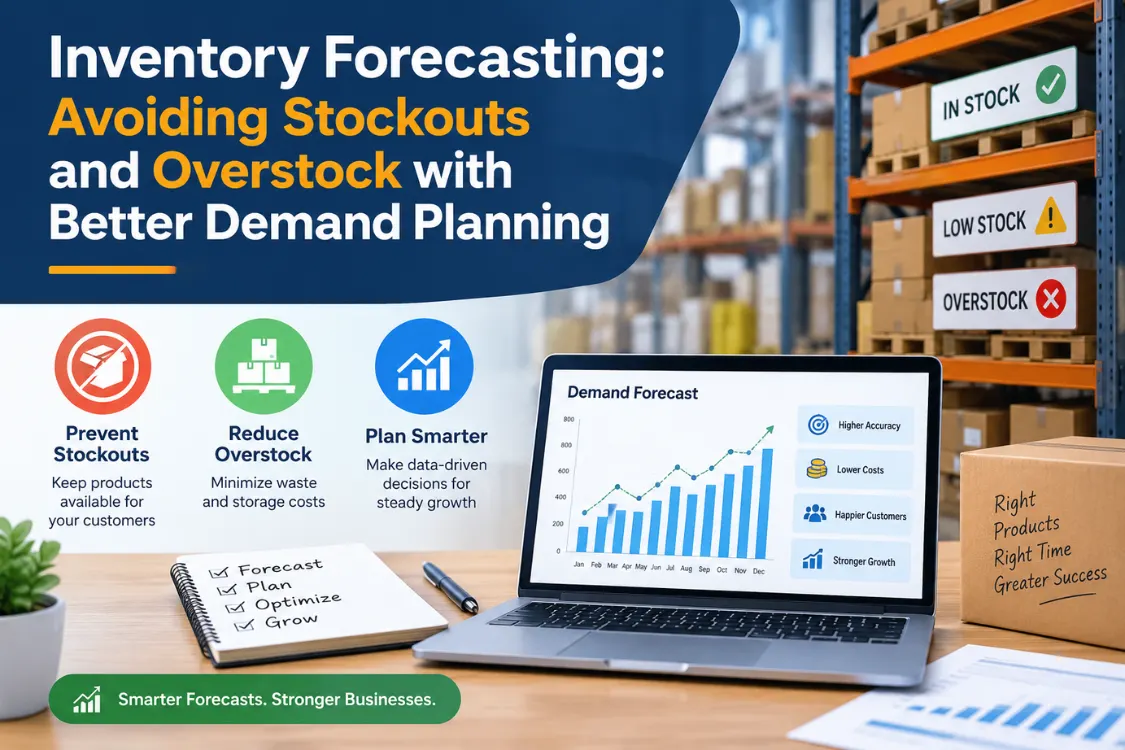
Product starts flying off the shelves. Orders keep coming in, and suddenly there isn’t enough stock to ship them all.
The reverse is also true. You order heavily for something that looked promising and find cartons sitting in storage months later.
The answer is inventory forecasting. Brands can make smarter stocking decisions through analysis of sales history, seasonality, promotions and current ordering trends. For ecommerce businesses that use a 3PL, accurate forecasting also means that the warehouse can get ready for changes in the volume of receiving, storage, picking, and shipping.
Why Inventory Forecasting Is Critical to Ecommerce Brands
One month 50 units might sell, the next 200. Then a promotion ends, demand falls, and those extra units remain in the warehouse.
Effective demand planning helps turn these changes into something you can plan against.
Instead of asking, “How much should we order?” look at:
- How fast is the SKU moving?
- Is demand increasing or slowing down?
- Are sales seasonal?
- Will a promotion create a spike?
- How long does replenishment take?
- How much safety stock is needed?
- How much inventory is available?
- How much is already allocated?
For a 3PL, this also helps plan labor, storage, receiving, and fulfillment capacity.
What is Demand Forecasting for Inventory?
Forecasting is more than looking at last month’s sales. An effective inventory demand forecasting process uses several data points to estimate future demand.
Sales Data History
Look at unit sales by SKU over several months to identify consistent demand and spikes.
SKU velocity matters. A product selling 30 units a day needs a different replenishment plan from one selling 30 units a week.
Seasonality and Promotions
Things like holiday shopping, Black Friday, product launches, etc. can affect typical buying patterns.
Add any increase in sales for an SKU during the promotion to the forecast. It also helps the 3PL prepare before the outbound volume spikes when you provide advance notice.
Lead Times
You also need to know how long it will take replacement inventory to come in.
If it takes a supplier six weeks to restock, waiting until the inventory is almost out of stock doesn’t leave much time to react.
If an SKU is selling 20 units a day and the supplier lead time is 30 days then there could be demand for around 600 units before replenishment arrives.
Current Inventory Status
The number in the WMS isn’t always the number available to sell.
Some units may be allocated to orders, damaged, held for a channel, or still being received.
A WMS might show 1,000 units on hand, while 150 are allocated and 100 are held as safety stock. Depending on the inventory rules, only 750 may be available for new demand.
How Improved Demand Planning Can Help Prevent Stockouts and Overstock
Stockouts and overstocking can both come from poor planning.
If you over estimate demand your cash is tied up in inventory that moves slow and storage costs increase.
If demand is underestimated, inventory levels may drop below what is needed to fill orders while replenishment is still on the way.
A practical tool is a reorder point. It triggers replenishment based on expected demand during supplier lead time plus safety stock.
Look at:
- Average sales velocity
- Recent demand changes
- Supplier lead time
- Safety stock
- Upcoming promotions
- Allocated inventory
- Current available inventory
If sales velocity or supplier lead time changes, the reorder point may need to change too.
How to Leverage a 3PL for Better Inventory Management
A 3PL is not a substitute for demand planning. It can provide better inventory data.
Real-time visibility shows what’s in the warehouse, what’s been allocated, and which products are moving fast.
Your fulfillment partner can also view the operational impact of changes in demand.
A sudden spike in orders can impact receiving, storage, picking and shipping. A warehouse that gets early warning of a promotion can prepare instead of scrambling when the orders start piling up.
Inbound inventory must be received, checked, processed and put away before it can be picked.
A Simple Example of Demand Forecasting for E-Commerce
Imagine a skincare company that sells 1,000 units of a product per month.
The brand has 300 units in safety stock and supplier lead time is four weeks.
33 units per day for four weeks is about 924 units in expected demand. If the brand only orders more when its inventory falls to 300 units, it risks running out before the inventory arrives.
Plus, a big influencer promo in the works.
If demand increases to 45 units per day, 4 weeks of demand is about 1260 units. The brand needs to account for that higher velocity when planning replenishment.
The business may need to order earlier and advise the 3PL about additional inbound and outbound volume. The warehouse can then plan receiving space, labor, and picking capacity.
This is where demand forecasting for ecommerce becomes practical. It is about spotting a likely change early enough to act on it.
Signs Your Forecasting Process Needs TLC
Look for:
- Frequently running out of bestseller SKUs
- Excessive slow-moving inventory
- Emergency replenishments
- Constant purchase order changes
- Deep discounts to clear old stock
- Non-moving products in the warehouse
- A large gap between on-hand and available inventory
- Replenishment arriving once SKU hits a critical level
If these patterns continue to occur, look at inventory allocation, receiving timelines, SKU velocity and supplier lead times, instead of just looking at sales data.
Improving Inventory Forecasting
You don’t need a sophisticated forecasting model to have clean data.
Review sales history, available inventory, lead time, and upcoming demand drivers by SKU. Separate fast moving products from slow moving products to not treat them the same.
More attention should be paid to the lead-time demand and the sales velocity of fast moving SKUs. Slower products may require a more lean approach to replenishment to avoid ordering inventory that isn’t moving.
Review forecasts regularly and communicate with your 3PL. Give the warehouse advance notice of any promotions, launches or seasonal events, so they can plan for receiving, storage, labour and fulfilment capacity.
Summary
Accurate inventory forecasting is not about nailing every number. It’s about making better stocking decisions before you get a stockout or an overstock that’s costly.
The next order comes in and the product availability is impacted by SKU velocity, lead-time demand, reorder points, safety stock, inventory on hand, inventory allocated, and the times to receive.
E-commerce brands can avoid stock-outs and overstock by improving demand planning, utilising accurate warehouse data and having a 3PL that can adjust to fluctuating order volume.
As your business grows and inventory management becomes more complex, speak with Relentless Fulfilment about how improved warehouse visibility and fulfilment support can help grow your operation.